CO2 Dry Ice Cleaning Blast for dealing with contaminants in the film coater manufacturing line.
Introduction
Ten years ago, we started the import and sales of "Dry Ice Blast cleaning equipment" produced by Alphews Co., USA. The equipment is effective for cleaning coaters, printing machines, interior walls of driers used in the film manufacturing line, nozzles, ducts, fans, and heat exchangers. Many recent client requests regarding coater rejuvenation (cleaning issues) prompted us to start providing cleaning work of coaters (driers, ducts, etc.).
The Dry Ice Blast cleaning equipment is superior in cleaning efficiency as compared to the traditional high pressure water or solvent cleaning methods due to the use of dry ice pellets or powders as the blasting medium. Furthermore, it does not damage cleaned surfaces as sand or grit blasting does.In addition, waste water and solvents treatments are not necessary.
History of developing the equipment
The concept of the Dry Ice Blast cleaning equipment originated at Lockheed in the 1970s while researching methods to peel off coated paints from aircrafts and developing an engine cleaning system.
Since then, this research center project team founded a company, CAE Alpheus Inc., in 1986.
It entered the US market in 1988,European market in 1990 and Japanese market in 1993 respectively. (USPT already granted)
Current cleaning technologies and environmental regulatory issues.
Listed here are the problems with current technologies and environmental regulations.
Solvent and chemical cleanings: PRTR (Pollutant Release and Transfer Register)
Toxic chemical substances discharged during commercial activities must be estimated and reported in terms of quantity and transfer.
It was adopted and recommended by the OECD (Organization for Economic Cooperation and Development) and enacted into law in Japan in July 1999.
Sand and Grit Blast cleanings: amended waste disposal treatment law in Japan
The Manifest Record system was enforced (industrial waste materials control system) for tracking and recording by extending the regulation of illegal waste material disposal to the waste generators so as to guarantee that industrial waste materials be collected and transferred for appropriate treatment.
High pressure water cleaning: Japanese Law preventing water pollution.
This is a law that was enacted in 1970 to prevent pollution of rivers and underground water from factory discharges.
These cleaning methods would require further research regarding environmental contamination through the examination of toxic chemical substances, workers' health problems, and recovery and disposal of solvents/sands/water.
CO2 Dry Ice Blast cleaning (Dry ice pellet cleaning)
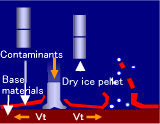
Dry Ice Blast cleaning
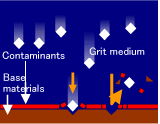
Grit medium cleaning
Figure 1. Comparison between Dry Ice Blast and Medium cleanings
Principles
High velocity dry ice pellets penetrate into the contaminants and/or coatings. Once they hit the base surface, the kinetic energy of the dry ice is released sideways, loosening the contaminants and paintings from the surface, thus removing them with a kind of "gas-phase wedge."
This type of internal cleaning action does not damage surfaces, nor significantly change dimensions as abrasive grits might do.
Figure 1.